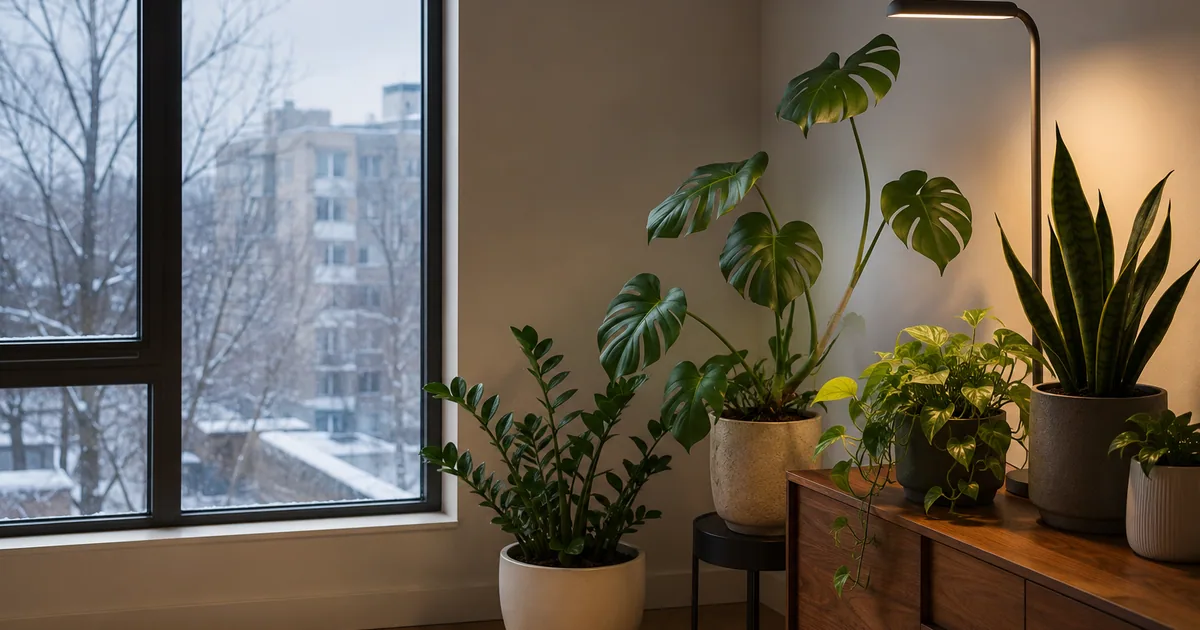
Quick answer: Winter low light often shows as slower growth, longer gaps between leaves, smaller or paler new leaves, leaning, or lower leaf loss. It also makes potting mix dry more slowly. Improve appropriate light first, then adjust watering to the new drying rate. Do not assume every yellow leaf is a light problem.
“Low light tolerant” does not mean “no light needed.” It usually means a plant can persist at lower usable light than a sun loving plant, often with slower growth.
If you are unsure whether the pattern is light, roots, or pests, use Plant Doctor’s browser diagnosis after photographing the whole plant in its normal location.
Signs that support low light
- New stems lean strongly toward the window.
- Gaps between leaves become longer.
- New leaves are smaller.
- Variegation becomes less distinct in some plants.
- Growth slows after days shorten or the plant moves farther from a window.
- The pot stays wet longer than it did in summer.
- Lower leaves yellow gradually without spreading lesions.
One sign is not enough. Root stress, nutrients, temperature, and pests can produce similar changes.
Compare light stress with overwatering
Low light and overwatering often form a cycle. Lower light reduces water use, while the old watering routine keeps mix wet.
| Observation | Light limitation | Root moisture problem |
|---|---|---|
| Growth | Stretching, leaning, small new leaves | Stalled growth, yellowing, collapse |
| Potting mix | Dries more slowly | Remains wet, heavy, or sour |
| Roots | Usually firm when otherwise healthy | May be brown, soft, or oxygen stressed |
| Direction | Plant grows toward light | Symptoms may be distributed more broadly |
Check both conditions. Improving light without correcting saturated mix may not be enough.
Find the best winter position
- Identify the plant’s species level light needs.
- Compare available windows at the time of day they receive useful light.
- Clean dusty leaves and window glass.
- Keep foliage away from cold glass.
- Move in steps if the new position has direct sun.
- Recheck temperature at night.
Window direction alone does not describe light. Buildings, trees, curtains, latitude, season, and distance from glass all matter.
The University of Georgia indoor plant guidance discusses how light intensity and duration affect plant growth.
When a grow light is useful
A grow light can help when:
- The best window remains too dim.
- The plant is actively producing weak stretched growth.
- You need to keep a plant away from cold glass.
- Natural light duration is short.
- A collection cannot fit near suitable windows.
Choose equipment designed for plant use, follow electrical safety instructions, and set distance and duration according to the lamp and plant. More intensity is not automatically better.
See grow lights versus window light for a deeper comparison.
Adjust watering after improving light
Do not change the plant’s light and water on an automatic schedule at the same time. Observe how the root zone responds.
- Check below the surface.
- Compare pot weight.
- Water thoroughly when ready.
- Let excess drain.
- Record the new interval.
If light increases, the pot may begin drying faster. Continue checking rather than fixing the interval permanently.
Rotate with purpose
Rotation can produce more even growth, but constant movement makes it harder to read the plant’s response.
- Let a recently moved plant settle.
- Rotate modestly at a consistent interval if the species benefits.
- Do not use rotation to compensate for fundamentally inadequate light.
- Photograph from the same angle to track leaning and new growth.
What not to do
- Do not place a shade adapted plant directly under an intense lamp without acclimation.
- Do not fertilize weak stretched growth instead of improving light.
- Do not keep summer watering frequency when the pot stays wet.
- Do not place leaves against cold winter glass.
- Do not assume yellowing proves low light.
The Colorado State University diagnosing plant disorders guide explains why environmental history and symptom pattern matter.
A two week improvement check
Judge progress by:
- Stable leaf color.
- Firmer new growth.
- Shorter, more typical spacing on new stems.
- A predictable moisture cycle.
- No continuing rapid leaf loss.
Old stretched growth will not compact itself. Evaluate the new growth produced under corrected conditions.
References
- University of Georgia Cooperative Extension. Growing Indoor Plants with Success.
- Colorado State University Extension. Diagnosing Plant Disorders.
- University of California Statewide IPM Program. Houseplant Problems.