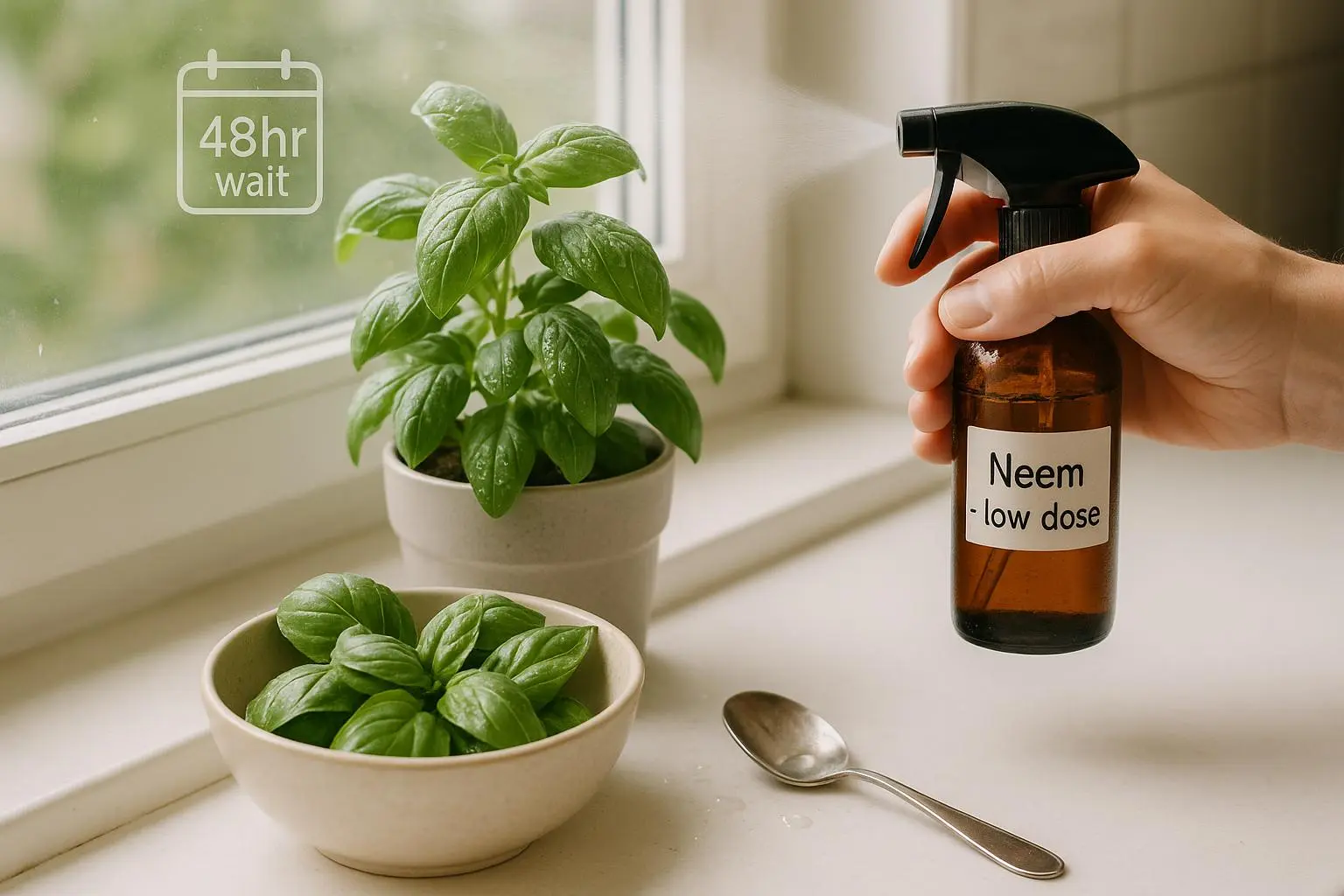
Yes, neem oil can be used on many edible plants when the product label lists the crop and you follow its dilution, timing, and harvest instructions. The label is the deciding authority because formulations differ. Do not use a generic online recipe in place of the directions on your bottle.
For the safest practical routine:
- Check that the label permits use on your crop and follow its pre-harvest interval.
- Follow the label's weather, timing, and pollinator precautions.
- Test a small area first, especially on tender herbs and leafy greens.
- Wait until the spray has dried before harvesting, even if the label permits a zero-day interval.
- Wash harvested produce under clean running water before eating it.
Some products permit same-day harvest, while others require a longer pre-harvest interval. Follow the interval on your product label. You may choose to wait longer to reduce visible film or off-taste, but an optional wait does not replace the label's safety instructions.
What this article covers
- How neem oil works and the practical differences between cold-pressed and clarified (neem oil extract)
- Why neem formulations and allowed crop uses differ
- How to use the label for application timing, mixing, frequency, and harvest safety
- How to follow a crop-specific pre-harvest interval (PHI)
- FDA produce-washing guidance
- Environmental and pollinator precautions
- A practical label and harvest checklist
1. Neem oil on edible plants: what it does and how it behaves in the garden
Neem oil is derived from the seeds of Azadirachta indica. Azadirachtin is one component that can deter insect feeding and disrupt insect growth and reproduction.
Products may contain cold-pressed neem oil, azadirachtin, or clarified hydrophobic neem oil, sometimes marketed as neem oil extract. These formulations are not interchangeable. Check the active ingredient, allowed crops, target pests, and directions on the label of the product you actually have.
In the United States, pesticide labels are legally enforceable. The label defines where, how, how much, and how often the pesticide may be used. Descriptions such as natural or plant-derived do not replace those requirements.
2. Application timing and concentration: follow the product label
Neem products differ in their active ingredients, concentrations, allowed crops, application rates, and harvest restrictions. Use only a product whose label permits your crop and intended use. The label determines how much to apply, how to mix it, how often to repeat it, and when you may harvest.
Key takeaways:
- Follow the label's weather and timing restrictions. Avoid strong sun, excessive heat, wind, and conditions that could carry spray onto people, animals, water, or other plants.
- Measure only the rate printed on the label. Do not substitute an online concentration or add dish soap, an emulsifier, or another pesticide unless the label instructs you to do so.
- Follow the label's coverage directions. Some products call for complete leaf coverage, while others limit where or how the product may be applied.
- Repeat only at the interval and maximum frequency permitted by the label. Do not adopt a preventive schedule unless that use is allowed.
A few quick, practical notes:
- If the label permits a small-area tolerance test, use it before treating a sensitive plant. Stop if you see injury and follow the product's instructions for phytotoxicity or accidental exposure.
- Keep people and pets away for any restricted-entry or drying period stated on the label.
3. PHI, wash-offs, and harvest windows: keeping residue to a minimum
For an edible crop, safe use depends on the product being labeled for that crop and on following its application and harvest restrictions. Washing cannot correct an application to an unlisted crop or a harvest that occurs before the required interval.
PHI (pre-harvest interval) reality
- Find the pre-harvest interval for your crop on the product label and count it exactly as directed. Do not replace it with a general neem-oil waiting period.
- If the label permits same-day harvest, complete every other application, drying, and washing instruction before eating the produce. Waiting longer for taste or appearance is optional and does not correct an off-label application.
Washing: the ultimate cleanup
- Rinse produce thoroughly under clean running water before preparing or eating it.
- Gently rub produce while rinsing. Use a clean produce brush on firm items when appropriate, then dry them with a clean cloth or paper towel.
- Do not wash produce with soap, detergent, or commercial produce wash. Washing also does not make an off-label pesticide application safe.
If produce remains visibly oily after the label's harvest interval and washing directions have been followed, do not improvise with stronger cleaners. Contact the product manufacturer or a local extension service for product-specific advice.
4. Cold-pressed vs clarified: check the active ingredient
Cold-pressed neem oil and clarified hydrophobic neem oil can have different active ingredients, concentrations, pests, crops, and directions. Do not choose a formulation only by its odor or appearance. Choose a product labeled for the crop and pest you need to treat.
Ready-to-use products and concentrates also require different handling. Apply a ready-to-use product only as packaged. Measure a concentrate exactly as its label directs, without borrowing a rate or additive from another neem product.
5. Environmental and plant-safety precautions
The National Pesticide Information Center reports that neem components break down in the environment over time. That fact does not determine when a treated crop can be harvested. The product's pre-harvest interval remains authoritative.
- Follow every pollinator precaution and avoid directly spraying bees or other beneficial insects.
- Keep the product and spray away from ponds, drains, and other water sources. Neem oil and azadirachtin can harm fish and other aquatic organisms.
- Follow temperature, sunlight, wind, runoff, and drift restrictions on the label.
- If the label permits a small-area tolerance test, check a limited part of the plant before broader application.
If the plant shows injury or the application reaches a person, animal, water source, or unlisted crop, stop and follow the label's incident and first-aid instructions.
6. Your pre-harvest checklist
Use this checklist together with the product label. It is not a substitute for crop-specific directions.
- Before application: confirm the crop, target pest, rate, application method, protective equipment, environmental precautions, and pre-harvest interval on the label.
- At application: record the product, crop, date, and time so you can calculate the label's interval accurately.
- Before harvest: confirm that the complete pre-harvest interval and any drying or restricted-entry period have passed.
- After harvest: rinse produce under clean running water. Do not use soap, detergent, or commercial produce wash.
7. How to read mixing and frequency directions
Do not convert a generic percentage into a home recipe. Instead, read the directions for your exact product:
- Ready-to-use products should be applied only as packaged and directed.
- Concentrates must be measured with the units and water volume printed on the label.
- Apply only to listed crops and target pests, using the permitted method.
- Observe the minimum interval between applications and the maximum number of applications.
- Follow the crop-specific pre-harvest interval, even when another neem product uses a different interval.
- Do not add soap, spreader, sticker, oil, or another pesticide unless the label permits that mixture.
Safety reminders
- Wear the protective equipment required by the label.
- Keep the product in its original container and away from children and pets.
- Protect pollinators, water, and nearby plants according to the environmental precautions.
- If exposure, a spill, or crop misuse occurs, follow the label's first-aid instructions and contact the manufacturer or appropriate poison-control service.
8. Regulatory notes and practical checks
Natural and organic are not substitutes for safe-use directions. Whether a product is permitted in an organic program depends on the exact product and use. Requirements also vary by country and jurisdiction, so check the product label and current guidance from your regulator or local extension service.
9. The big picture: why neem oil can work for you
Neem is one possible pest-management tool, but it is not appropriate for every pest, crop, or growing condition. Confirm the pest first and consider nonchemical controls before applying any pesticide.
If you’re new to this, choose a product labeled for your crop and pest, read the entire label before mixing or spraying, and record each application. Wash harvested produce under running water before eating it.
Quick FAQ
Is neem oil safe on edible plants?
Neem oil can be used on an edible herb, vegetable, or fruit only when the product label permits that crop and you follow its mixing, application, harvest, and washing directions.
How long should I wait to harvest after spraying neem oil?
Follow the exact pre-harvest interval on the product label for your crop. If the label permits same-day harvest, also follow every drying and washing direction it provides.
Should I wash vegetables after using neem oil?
Yes. Rinse produce thoroughly under clean running water. Gently rub produce while rinsing, use a clean produce brush on firm items when appropriate, and dry with a clean cloth or paper towel. Do not use soap, detergent, or commercial produce wash.