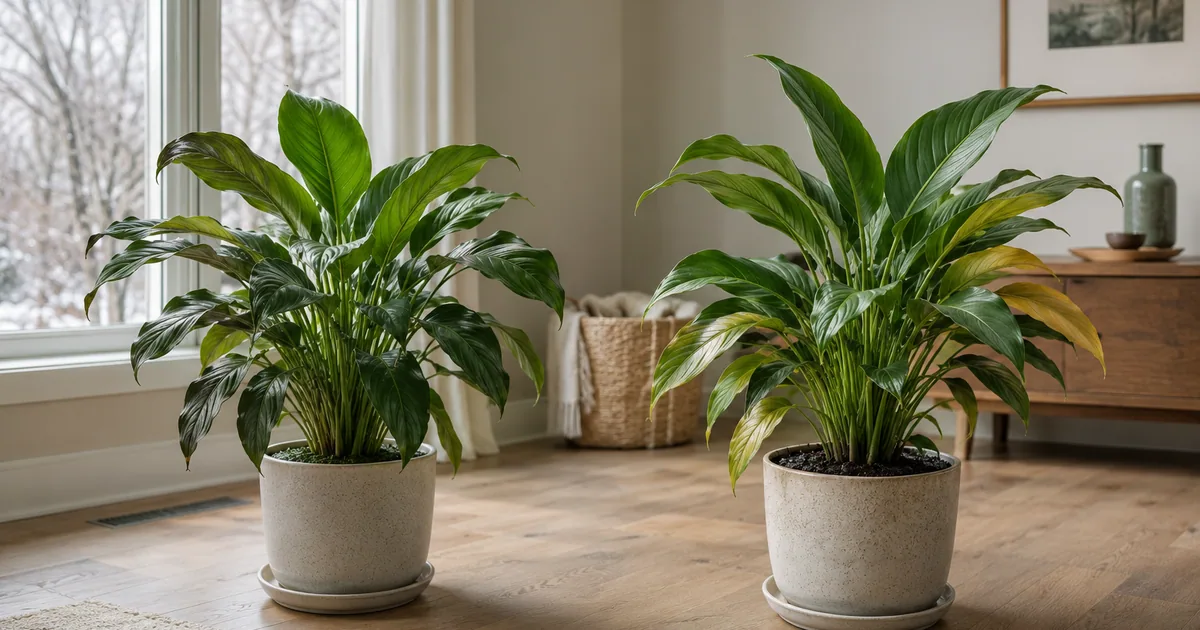
Quick answer: Cold draft damage often appears soon after exposure and is strongest on leaves nearest a door, window, vent, or cold glass. Overwatering is more closely associated with persistently wet mix, a heavy pot, yellowing, soft roots, or a sour smell. Both can occur together because cool, low light conditions slow drying.
Do not choose a treatment from leaf color alone. Reconstruct the exposure, check the root zone, and map where symptoms occur on the plant.
You can upload clear context and leaf photos to Plant Doctor’s browser diagnosis after completing the checks below.
Side by side clues
| Clue | Cold draft or chilling | Overwatering or root stress |
|---|---|---|
| Timing | Follows an open door, transport, cold night, or contact with glass | Develops while mix remains wet across repeated checks |
| Location | Exposed side or leaves nearest the cold source | Can affect the plant more broadly |
| Leaf feel | Water soaked, darkened, limp, or later crisp | Yellow, limp, soft, or edematous |
| Pot | May be normally moist or dry | Often heavy with slow drainage |
| Roots | May remain firm | May be brown, soft, or sloughing |
| Smell | No characteristic root smell | Sour or stagnant smell may occur |
These patterns guide the next inspection. They do not rule out pests, fertilizer injury, disease, or ordinary leaf aging.
Reconstruct cold exposure
Ask:
- Did the plant touch window glass overnight?
- Was a door left open?
- Did the plant travel in cold weather?
- Is it beneath an air conditioning or ventilation outlet?
- Did indoor heating fail?
- Are symptoms concentrated on the exposed side?
Damage can appear after the event, so a plant may look normal immediately after transport.
Check for excess moisture
Look deeper than the soil surface.
- Lift the pot if practical.
- Insert a clean skewer or finger into the root zone.
- Check whether drainage holes are open.
- Remove the inner pot from the cover pot.
- Smell the drainage area.
- Inspect roots if the plant remains limp in wet mix.
The University of Illinois Extension drowning and edema resource describes how excessive water and low oxygen can damage plant tissue.
Immediate response to suspected cold damage
- Move the plant to a stable, appropriate temperature.
- Keep it in bright indirect light.
- Avoid direct heat from a radiator or hair dryer.
- Water only according to root zone need.
- Leave stable damaged leaves attached until the extent is clear.
- Remove tissue that becomes fully dead or soft with clean tools.
- Pause fertilizer during recovery.
Warm the environment gradually. Rapid heating does not reverse injured cells.
Immediate response to suspected overwatering
- Stop watering.
- Empty standing water.
- Improve appropriate airflow.
- Correct blocked drainage.
- Inspect roots when smell, softness, or decline continues.
- Repot only if the root condition or failed mix requires it.
The root rot recovery guide provides a cautious inspection and repotting process.
When both are involved
Cold seasons often produce a combined problem:
- Light decreases.
- Potting mix dries more slowly.
- A summer watering schedule continues.
- Cold exposure injures leaves or roots.
- Wet, cool mix slows recovery.
Correct the environment and moisture decision together. Moving the plant away from the window without changing repeated watering leaves half the problem in place.
Prevent cold and moisture injury
- Keep sensitive foliage away from cold glass.
- Use a stable interior position during extreme nights.
- Check the root zone before each watering.
- Water earlier in the day when a cold room is expected overnight.
- Keep drainage water out of cover pots.
- Improve appropriate winter light.
- Avoid transport without insulation in cold weather.
The Colorado State University temperature and humidity guidance explains that houseplant temperature needs vary and interact with humidity.
When the pattern needs expert diagnosis
Seek further help when:
- Dark or water soaked areas keep spreading.
- Several plants show lesions without sharing a cold exposure.
- The crown is soft.
- Roots are extensively damaged.
- The plant is valuable, rare, or potentially regulated.
Save the timeline and photos. The Colorado State University diagnosing plant disorders guide highlights the importance of pattern and environmental history.
References
- University of Illinois Extension. Drowning and Edema.
- Colorado State University Extension. Houseplants: Temperature and Humidity.
- Colorado State University Extension. Diagnosing Plant Disorders.