Fungus gnats in an apartment feel like a tiny conspiracy—they’re annoying, they’re fast, and they always seem to show up right when you’re trying to keep a few herbs alive. I’ve been there. In a two-room apartment with a dozen pots, every watering becomes a decision: is this the moment I finally wipe out the gnats or do I risk drenching the soil and inviting root rot?
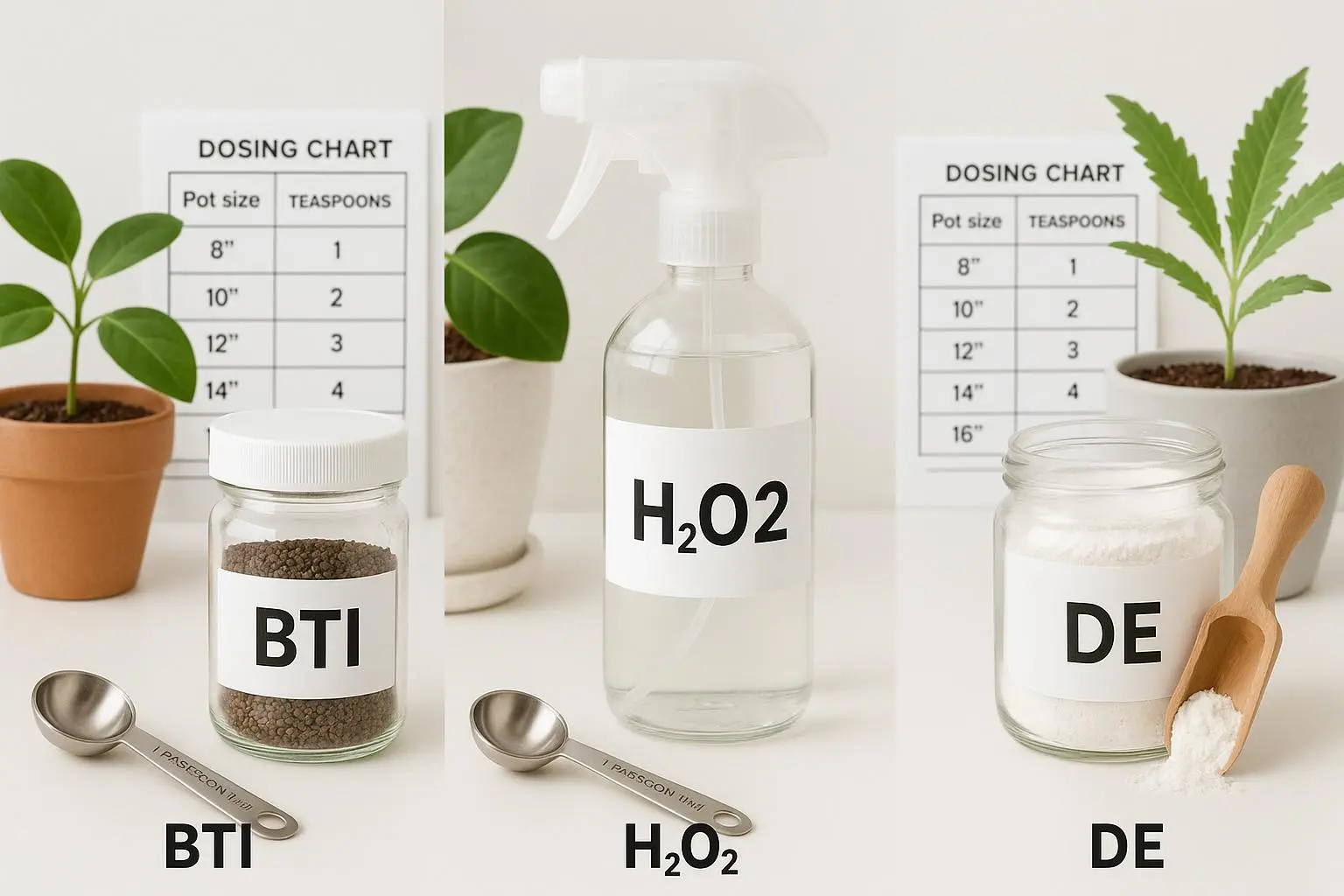
What you’re about to read is a practical guide, not a chemistry lecture. I’ll break down three popular tools—BTI, hydrogen peroxide (H2O2), and diatomaceous earth (DE)—in plain language. You’ll get exact dosages, how much to apply by pot size, and timelines you can actually rely on. Then I’ll show you how to mix, match, and rotate these methods to speed up results without turning your living room into a lab.
And yes, there’s a real story in here. A short, human, imperfect story, because this stuff only works if you’ve actually tried it in a real space with real plants and real life.
First, a quick moment I won’t forget. I stood in a 60-square-foot balcony with a mist of warm sun, watching a single yellow sticky trap flutter in the breeze. It caught its first gnat within 30 minutes. That tiny orange square became my weather report: the population was real, but trackable. It made the whole plan feel doable.
What’s inside this guide
- How each method works and when it shines
- Exact dosages and application volumes by common pot sizes
- Timelines you can expect, with notes on variability
- Pet, edible plant, and human safety
- A simple, repeatable rotation plan for quick wins
- Real apartment mini-studies to show what actually happened in the field
Understanding the Enemy: Fungus Gnats in Small Spaces
Fungus gnats aren’t a direct threat to most houseplants the way a real pest like a scale insect would be. But their larvae feast on roots and root hairs, slowing growth and turning healthy soil into a war zone for seedlings and young plants. In small spaces, too much moisture or too much intervention too soon can backfire: you can drown roots, burn sensitive herbs, or blacken soil with dust. The trick is to attack the life cycle at multiple points without creating new problems.
BTI, Hydrogen Peroxide, and Diatomaceous Earth: What They Do (And What They Don’t)
BTI (Bacillus thuringiensis israelensis)
- How it works: It’s a biological control. When larvae ingest the BTI toxins, their guts are damaged and they die. It targets larvae living in the top layer of the soil.
- Strengths: Highly effective for larvae; relatively safe for humans, pets (in typical garden-use concentrations), and edible plants.
- Limits: Slow to show effects because you’re waiting for the larval life cycle to run, and you’re fighting a population that’s already hatched.
Hydrogen Peroxide (3% solution)
- How it works: A chemical oxidizer. Diluted H2O2 kills larvae on contact and can aerate the soil, giving plant roots a little breathing room in the short term.
- Strengths: Quick knockdown of newly hatched larvae; easy to mix; leaves no chemical residue if diluted properly.
- Limits: Repeated use can disrupt beneficial microbes and, if not diluted carefully, may burn roots or pale leaves.
Diatomaceous Earth (Food-grade)
- How it works: A mechanical pesticide. The fine, sharp particles abrade an insect’s exoskeleton. It’s most effective when the soil surface is dry.
- Strengths: No chemical residues; simple to apply; effective against crawling adults that touch the powder.
- Limits: Works best when soil is dry; can be messy; inhalation risk if you’re not careful; heavy use can dry out potting mix and slow water uptake.
Dosages and Application by Pot Size (Concrete Numbers You Can Actually Use)
BTI (activated product)
- Activation: Most BTI products are a dry powder that you activate with water. Mix as directed on the package, and use within about an hour before it breaks down.
- Small pots (4-6 inches): 1-2 tablespoons of activated BTI solution per pot
- Medium pots (8-10 inches): 3-4 tablespoons per pot
- Large containers (12+ inches): 6-8 tablespoons per pot
- Watering note: If your plants are thirsty, water first, then apply. Don’t overwater to avoid runoff that can wash away BTI.
H2O2 (3% solution)
- Dilution: 1 part 3% H2O2 to 4 parts water (a 1:4 dilution)
- Small pots: 2-3 ounces of the diluted mix per plant
- Medium pots: 4-6 ounces per plant
- Large pots: 8-10 ounces per plant
- Schedule: Apply every 3-4 days for 2-3 weeks. If you’re using sticky traps, keep traps in play to gauge progress.
Diatomaceous Earth (Food-grade)
- Soil surface: A light top-dressing of about 1/8 inch (roughly a light dusting)
- Application cadence: After watering, reapply when you see powder damp or when the soil surface dries out again
- Important safety: Use a mask rated for fine particulates; keep away from kids and pets; DE loses efficacy when wet, which means you’ll have to reapply after watering
What to Expect: Timelines and Realistic Outcomes
BTI
- When it works best: In setups with multiple plants and a healthy moisture balance, larvae in the topsoil are refilled as adults lay more eggs. BTI cleans up the larvae population within 3-7 days, and a second application after 7-10 days can lock in control for heavier infestations.
- Typical result window: A noticeable drop in larval activity and adult emergence within the first week; complete or near-complete suppression in 2-3 weeks in many apartment conditions.
Hydrogen Peroxide
- When to choose: If you’re facing an immediate surge of larvae and you need a quick shock to the system.
- Timeline: Expect visible results in 1-2 weeks with steady treatment every 3-4 days. You’ll see fewer adults as eggs and larvae are eliminated.
- Caveat: A few days of good progress can stall if you don’t continue the schedule or you disrupt the soil biology too much. Sticky traps help you know whether you’re moving in the right direction.
Diatomaceous Earth
- When to use: If you want a visible, physical barrier that reduces adult landings on the soil surface. It’s a slower march, not a sprint.
- Timeline: Often 1+ week before you notice meaningful changes, and you’ll likely reapply after each watering. In a busy apartment, this can become labor-intensive.
- Biggest challenge: It dries the surface where you need it to work, but you’ll have to live with the extra dust and extra watering discipline.
Pet, Edible Plant, and Human Safety: Quick Guide
BTI
- Pet safety: Generally safe for pets at standard usage levels; it’s considered non-toxic in the context of typical home use.
- Edible safety: Safe for herbs and vegetables; breaks down quickly and targets only the larvae of certain pests.
Hydrogen Peroxide
- Pet safety: Safe at 3% dilution when used as directed; make sure pets don’t drink concentrated solutions and avoid soaking the plant canopy.
- Edible safety: When diluted properly as a soil drench, it’s generally safe for edible plants. Don’t apply directly to leaves or edible parts in high concentrations.
Diatomaceous Earth
- Pet safety: Not ideal for homes with pets, especially if inhaled. It’s a respiratory irritant and should be used with caution around animals.
- Edible safety: Food-grade DE is used by some growers for edible setups, but it should be kept away from pets and eventually avoided near harvest-time areas to prevent residue on edible surfaces.
Rotation and Combine: A Simple, Effective Plan
If you want fast results with minimal risk, here’s a straightforward rotation that has worked for me in a small apartment with a dozen pots.
Week 1: BTI + Sticky Traps
- Apply activated BTI to the soil of every plant.
- Place yellow sticky traps on each plant (2-3 on large plants, 1 on small).
- Check traps daily to gauge adult emergence.
Week 2: H2O2 Refresh
- Switch to hydrogen peroxide for the soil drench every 3-4 days.
- Keep traps active; the idea is to choke off the larvae while you’re damping the soil with the oxidizer.
Week 3-4: Continue H2O2, Evaluate
- If you still see gnats, extend H2O2 treatments another 1-2 weeks.
- If the population has dropped sharply, you can start to taper to maintenance (e.g., every 7-10 days) and keep traps on for a few more weeks.
Maintenance (Weeks 5-6 and beyond)
- Sticky traps stay in place for 4-6 weeks total as a monitoring system.
- Adjust watering to avoid constantly damp soils (fungus gnats love that).
- If new adults appear on traps, reapply BTI as a preventive drench.
Avoid DE in most apartment scenarios unless:
- You have no pets or kids
- You’re comfortable with bottom-watering to keep the surface dry
- You’re prepared for the extra cleaning and potential dust cleanup In other words, DE is a powerful tool but its drawbacks aren’t trivial in the average home.
Real Apartment Case Studies: What Happened When I Tried It
Case Study A: The Cat-Shared Studio (BTI + Traps)
- Setup: 12 medium pots; one curious cat; small kitchen herb shelf
- Tactics: Day 0: BTI drench across all pots; yellow sticky traps on every plant; a simple 1-2 minute daily check routine
- Timeline: By Day 5, the traps showed about 80% fewer adults; by Day 10, many pots no longer had visible gnats flying around
- Outcome: Complete suppression by Day 18 with only occasional adults showing up after the initial flush. The cat never showed signs of distress, and the soil stayed moist enough for healthy plant growth.
Case Study B: The Herb-Drenched One-Bedroom (BTI + H2O2)
- Setup: 25 plants including herbs (basil, mint) and a few leafy greens
- Tactics: Week 1 - BTI drench everywhere; Week 2 - switch to H2O2 every 3 days
- Timeline: Herb leaves remained clean; soil was consistently aerated; gnats declined dramatically by Day 21
- Outcome: Edibles remained safe and productive; harvests continued with little interruption. The owners reported a noticeable lull in adult gnats within the first two weeks.
Case Study C: The Ventilation-Challenged Shared Space (DE cautionary tale)
- Setup: Moderate infestation; shared living area; no pets but poor ventilation
- Tactics: Tried DE but concerns about dust and the need for long dry periods made it impractical; pivoted to H2O2 + traps
- Timeline: Initial improvement took longer (about 7 days to notice progress); complete eradication by Day 18
- Outcome: No respiratory issues, and the pest was eventually controlled without needing to resort to DE’s dust in such a shared space.
Final Recommendation: The Short, Honest Take
For most small homes, BTI is the winner. It’s fast enough to make a dent quickly, safe enough to use around edibles and pets, and it doesn’t demand the daily maintenance that DE requires in a busy apartment. If you’re dealing with a stubborn infestation or you’ve got a bigger plant collection, rotate to H2O2 after the first BTI flush to knock down new larvae and keep the cycle from continuing.
If speed isn’t your top priority and you’re dealing with a pet-free, well-ventilated space, you can consider a light DE barrier for immediate adult control. Just be prepared for the dust, the dry-down you’ll need to enforce, and the extra day-to-day care to keep soil moist enough for plant health.
A few practical tips that can save you time and money
- Start with a clean slate: Before you start any treatment, take a quick inventory of your watering habit. Fungus gnats thrive where soil stays wet. A minor tweak to your watering schedule can magnify the impact of BTI or H2O2 treatments.
- Don’t skip traps: Sticky traps aren’t just bait—they’re your feedback loop. If the traps show more adults after a round of BTI, it’s a sign you might need a second application or a switch to H2O2.
- Keep it quiet and steady: The best pest plans don’t scream; they whisper. A calm, consistent routine beats sporadic spraying. It’s easier on your plants and your nerves.
- Record the outcome: A quick log on your phone about dates, pot sizes, and what you used helps in future infestations. You’ll be surprised how helpful it is when gnats come back after a move or a season change.
Final thought: you don’t have to choose one weapon forever. The fastest way to win indoors is to combine a short, high-impact BTI treatment with a deliberate H2O2 rotation. Add sticky traps as your constant, quiet sentinel, and you’ll see a real difference in a few weeks.
References
- Various gardening experts and product guides (BTI activation, H2O2 use, and DE cautions). See notes above for context.